
Forums

Guidance, support and wisdom to benefit and maximize the life and longevity of animals.
 ×
×
×
×
×
×
×
×
with a password reset link.
Be sure to check your SPAM folder if it's not in your inbox
Can't find it?
Need Help? Contact Us
×
Guidance, support and wisdom to benefit and maximize the life and longevity of animals.

VetVine Client Care

It can be challenging to assess pain or discomfort in animals. Limping is an obvious sign, but not all pain causes limping (e.g. abdominal / visceral pain, neuropathic pain, etc). Cats, in particular, are adept at hiding visible signs of pain. Cats with painful osteoarthritis, for example, rarely show signs of limping. As such, researchers – for years – have been exploring other means for assessing pain in animals – including the utility of examining changes in their facial expressions as an indicator. Those efforts have led to the development of grimace scales for use in farm animals, companion animals, and in the laboratory animal setting.
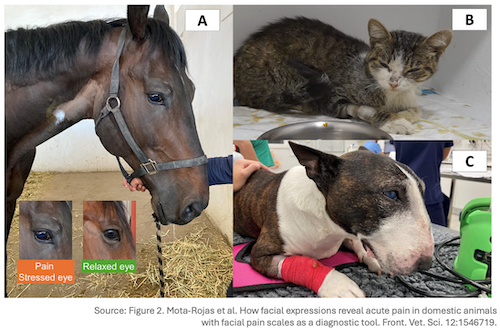
More than a decade ago, investigators began exploring whether changes in a cat’s facial features could correlate with acute pain. At the onset of one study1, a majority of untrained observers struggled to identify pain-free from painful cats — only about 13% could correctly identify painful cats. The researchers then determined six key facial factors that differed significantly between pain-free and painful cats (e.g. ear position and areas around the mouth or muzzle, etc). Using specific anatomical markers and measurable distances they established standardized mouth and ear distance measurements in cats. When measured and combined, observers could distinguish painful from non-painful cats with 98% accuracy.
Stemming from that work, the Feline Grimace Scale (FGS) was developed and is now regarded as a valid and reliable instrument for assessing acute pain in cats.2,3,4
The FGS focuses on five “action units” (AUs) — distinct facial features that change in painful states:

This tool has shown a strong correlation with established pain scales like the Glasgow Composite Pain Scale – Feline.5 The FGS has good inter-rater reliability (different people tend to score similarly when using it correctly), and it is sensitive to changes in cats before and after they've been provided analgesia (confirming it reflects real pain levels). The FGS is now widely used in both clinical and research settings.
A recent review article6 summarized research regarding the use of grimace scales – as a diagnostic tool or indicator of pain – in a variety of other species including horses, pigs, sheep, cattle, and laboratory animals (mice, rats, rabbits, ferrets, guinea pigs). One notable exception is that, to date, there is no validated grimace scale for dogs (though other types of pain scales have been developed for dogs with skin, neurologic, and orthopedic conditions).
They further explain the neurobiology of the link between pain and changes in facial expression.
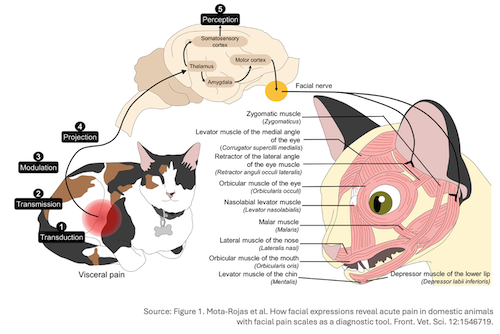
When an animal experiences pain, parts of the central nervous system (e.g. the somatosensory cortex, prefrontal cortex, amygdala, hippocampus, and hypothalamus) become activated. These areas have connections with the motor cortex of the brain, which in turn controls the facial muscles. Initiation of those motor responses are reflected by changes in facial expressions – which, again, correlate with pain.6
Most animals are “wired” to hide pain – they don’t display obvious clues and, consequently, suffer in silence. Having an understanding of common and subtle behavior changes in animals is important and can help support a suspicion of pain. When it comes to assessing pain, however, our observations are subjective and often inaccurate. In our quest to provide animals a best, pain-free quality of life, we are fortunate to have tools that can help us to objectively identify and measure pain, as well as these non-invasive, validated grimace scales.
References:
[1] Evaluation of facial expression in acute pain in cats. J Small Anim Pract. 2014 Dec;55(12):615-21. doi: 10.1111/jsap.12283. Epub 2014 Oct 30. PMID: 25354833.
[2] Facial expressions of pain in cats: the development and validation of a Feline Grimace Scale. Sci Rep. 2019 Dec 13;9(1):19128. doi: 10.1038/s41598-019-55693-8. PMID: 31836868; PMCID: PMC6911058.
[3] Wikipedia contributors, "Grimace scale," Wikipedia, The Free Encyclopedia, https://en.wikipedia.org/w/index.php?title=Grimace_scale&oldid=1315362732 (accessed December 17, 2025).
[4] Understanding the Feline Grimace Scale: A study of dimensional structure, importance of each action unit and variables affecting assessment. The Veterinary Journal. December 2025. Vol 314:106448. doi.org/10.1016/j.tvjl.2025.106448
[5] Glasgow Feline Composite Measure Pain Scale: Feline: https://wsava.org/wp-content/uploads/2020/01/Feline-CMPS-SF.pdf
[6] How facial expressions reveal acute pain in domestic animals with facial pain scales as a diagnostic tool. Front. Vet. Sci., Sec. Animal Behavior and Welfare. 03 March 2025. Volume 12. https://doi.org/10.3389/fvets.2025.1546719
This is an open-access article distributed under the terms of the Creative Commons Attribution License (CC BY)