
Forums

Guidance, support and wisdom to benefit and maximize the life and longevity of animals.
 ×
×
×
×
×
×
×
×
with a password reset link.
Be sure to check your SPAM folder if it's not in your inbox
Can't find it?
Need Help? Contact Us
×
Guidance, support and wisdom to benefit and maximize the life and longevity of animals.

VetVine Client Care

Discussion about heartworm prevention is part of virtually every wellness exam, yet prevention compliance is seemingly still inconsistent. Survey data reported by Banfield Pet Hospital in 20231 provides some insight as to why: the gap isn't about access to preventives, it's centered around beliefs. Too many dog and cat owners mistakenly believe that heartworm does not apply to their pet, is not a concern in their geographic location, or that risk is just a seasonal thing. However, the reality is much different and the scope of the problem is reinforced by some sobering facts.
The American Heartworm Society (AHS) estimates that more than a million pets in the U.S. currently carry heartworm, and the incidence of infection continues to trend upward. The geographic distribution is shifting, too. The AHS's most recent (2025) nationwide incidence survey2 found that there is no state in the U.S. that is heartworm-free, and that case density is climbing in areas that, historically, had low rates of infection (parts of the interior West and upper Midwest among them).
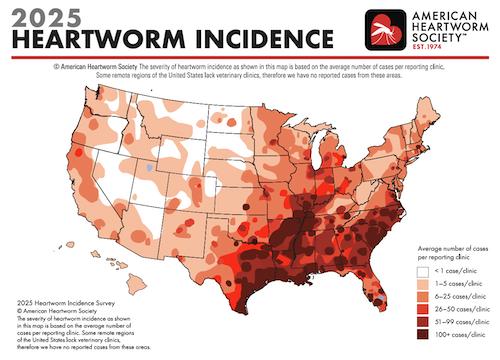
Source: American Heartworm Society 2025 Incidence Survey
Wildlife reservoirs moving into populated areas, pet relocation through adoption programs, severe weather events, and a longer transmission season are all cited as contributing drivers. The bottom line is that heartworm is not a static or regional risk — it's a moving target, and this information needs to be conveyed to pet owners. While veterinary practices may be talking about heartworm testing and prevention, there is clearly a gap in how dog and cat owners are receiving and acting on the information, and this is evidenced by the incidence map that is updated by the AHS every two years. We also have other data to support this — a client survey conducted by Banfield Pet Hospital1 (coupled with their own medical record analysis) found that:
Of note, Banfield's own 2023 case data showed that diagnosis rates were essentially flat across all four seasons — direct clinical evidence that the "warm weather only" belief (that's driving seasonal dosing vs. year-round prophylaxis) is erroneous.
Like any recommendation, we are more likely to be effective in gaining adherence if we reframe our talking points to create an understanding of “why” rather than lecturing or reciting guidelines. Here are a few suggested ways to reframe heartworm discussion points that can help to address client misconceptions:
Additionally, here are a few technical points regarding the importance of annual heartworm testing that are worth repeating, as well as some practice pearls:
Veterinary practices should be positioning annual heartworm testing and year-round prevention as an important component of preventive wellness care — on par with vaccination protocols — and not as an "upsell" or a discretionary recommendation. Consider integrating something similar to Banfield's messaging around "chasing zero" heartworm infections: prevention is safer, easier, and meaningfully cheaper than treatment, and it's one of the few serious pet diseases that's nearly 100% preventable when protocols are followed.
Let's crowdsource some ideas and solutions! We'd like to hear from our Members on this topic. Does your practice track heartworm testing and preventive adherence / compliance? Have you seen improvements with any specific type of initiative or effort? If so, what worked (e.g. messaging or communication and who in the practice is delivering that)? Have you had success in transforming a reluctant owner into one who commits to heartworm prophylaxis? Login to share what’s worked in your practice.
References:
New pet owner survey suggests common myths fueling significant gaps in prevention of deadly parasite for U.S. dogs and cats. PR Newswire. April 2024.
The American Heartworm Society - 2025 Heartworm Incidence Survey (released in April 2026).